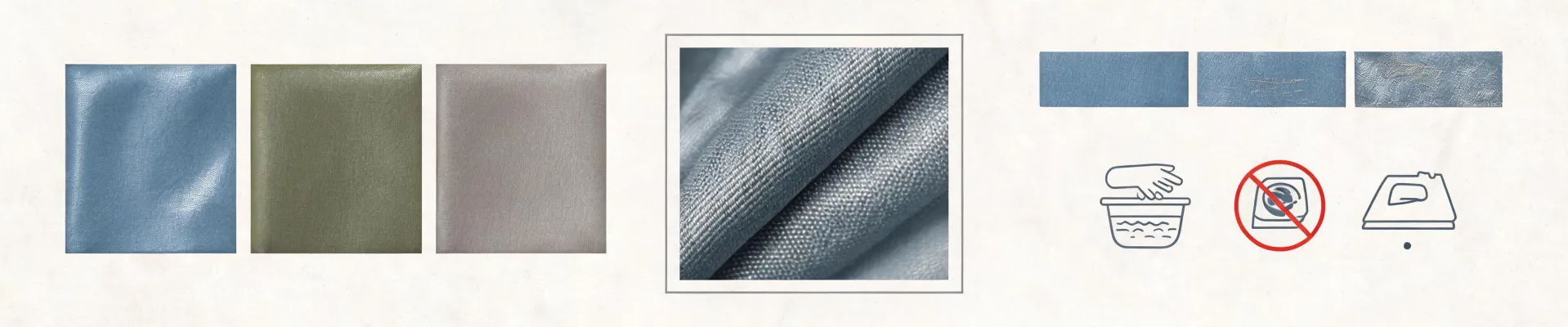
-
Who this checklist is for
- Step 1: Put every spec in writing—with tolerances
-
Step 2: Request samples from a production run—not the sales kit
-
Step 3: Run your own water and UV test
-
Step 4: Quantify color consistency with Delta E
-
Step 5: Get specific about what "PU leather" actually means
-
Step 6: Calculate landed cost—not unit price
-
Step 7: Verify compliance documentation
-
What to watch out for
Who this checklist is for
This is for B2B buyers, product developers, and OEM brand owners who are sourcing PU leather in bulk or vetting a Spradling marine vinyl distributor—and who'd rather catch problems before the container ships than after.
I'm a quality and brand compliance manager at a furniture and marine upholstery company. I review roughly 300 rolls a year before they reach our customers—call it six rolls a week, more during peak season (our Q3 is always brutal). About 15% of first deliveries fail my spec check. Not cosmetic stuff. Real deviations that force a return or rework. In 2023 alone, that 15% translated to roughly $47,000 in wasted freight, labor, and delayed shipments.
Here's the 7-step process I run on every bulk order. None of it is rocket science. But skipping any single step has cost me—sometimes a few hundred dollars, once about eleven grand.
Step 1: Put every spec in writing—with tolerances
This is the foundational step, and it's the one people skip most. A verbal agreement or a handshake over WeChat isn't a specification. It's a hope.
In my first year, I made the classic rookie mistake: assumed "standard" meant the same thing to every vendor. It doesn't. One supplier shipped a batch where "standard thickness" meant ±0.3mm against a nominal figure. We needed ±0.1mm. That batch was rejected outright—they redid it at their cost, but our production line sat idle for eight days.
Now every PO includes: weight per square meter, thickness in mm, width, color reference (Pantone number), backing type, surface finish, roll length, and packaging spec. Every line has a number and a tolerance. If a supplier won't sign off on tolerances, that's your first red flag.
What to actually write down
- Thickness: nominal + tolerance (e.g., 1.2mm ±0.1mm)
- Weight: GSM with ±5% tolerance
- Color: Pantone TCX number, not a photo
- Backing: knitted, woven, or non-woven—be specific
- Surface: embossed pattern name or reference sample number
Step 2: Request samples from a production run—not the sales kit
Sales samples are marketing materials. You need actual production samples.
I ask for two things: a "golden sample" (their absolute best) and three random rolls pulled from a live production run. Then I compare them. If there's a visible color shift between the sales kit and the production pull, you've already learned something important about their QC process.
For Spradling marine vinyl, I pay close attention to surface texture consistency. The Softside line specifically has a softer hand-feel than standard marine vinyl—if the sample feels like stiff plastic, either the batch is off or they're upselling you on a product line name.
Here's a lesson I learned the hard way: a supplier's sample looked perfect. The production batch had a different formulation—they "optimized" it. We didn't catch it until 80 rolls of bulk sofa leather were already in our warehouse. That one cost us about $4,200 in returns and two weeks of back-and-forth.
Step 3: Run your own water and UV test
For marine vinyl, don't take "waterproof" at face value. Verify it.
We're based in a high-UV area, so I run a basic test: cut a sample, submerge half in water for 72 hours, and leave the other half on a south-facing window ledge for two weeks. Then compare.
What I look for: color migration (dye bleeding), stiffening (plasticizer loss), edge curling, and surface bubbling. A genuine marine-grade vinyl holds up. Cheap PU sofa leather usually fails—sometimes spectacularly.
I don't have hard data on industry-wide failure rates here—we've only tested maybe 200 samples internally—but my sense is that 10-15% of products marketed as "marine grade" don't survive the water test. That's not a small number.
Step 4: Quantify color consistency with Delta E
Human eyes are unreliable. "Looks close enough" is often wrong.
The industry standard for brand-critical colors is Delta E under 2. A Delta E of 2-4 is noticeable to trained observers; above 4 is visible to most people (Pantone Color Matching System guidelines).
I pull 5 rolls from each batch and measure 3 points per roll. If Delta E exceeds 3, I call the supplier. Above 5, the batch goes back. Our rework rate dropped from 22% to about 6% within six months of implementing this step in mid-2022.
Most buyers skip this step. It's tedious, requires a spectrophotometer, and costs money. But when your customer returns a sofa because the leather doesn't match the showroom sample, you'll wish you'd spent the $200 on testing instead of the $2,000 on reverse logistics.
Step 5: Get specific about what "PU leather" actually means
"PU leather" is a catch-all term that can mean anything from a high-quality polyurethane-coated fabric to a thin plastic film laminated to a paper-thin backing. Five years ago, most buyers didn't ask follow-up questions. In 2025, you can't afford not to.
For bulk sofa leather orders, ask:
- Is the top layer PU or PVC? (PU is generally softer and more breathable; PVC is cheaper and more durable)
- What's the thickness in mm?
- What's the backing material?
- Is there a protective topcoat or treatment?
- What's the expected lifespan under normal use?
If a leather fabric supplier can't answer these without checking with someone else, that tells you something. Move on.
Step 6: Calculate landed cost—not unit price
The sticker price is the starting point, not the final number.
True cost per unit includes:
- Freight per batch (ocean or air)
- Customs and import fees
- QC inspection time (yours or a third party's)
- Return rate allowance (budget 5-15%, depending on supplier)
- Production downtime if delivery is late
I built a simple spreadsheet comparing landed cost across three suppliers. The cheapest one—by unit price—ended up 12% more expensive once returns and delays were factored in. That's the real PU leather wholesale cost guide: not price per meter, but total cost of ownership.
Step 7: Verify compliance documentation
I won't make blanket compliance claims without knowing your specific market. But here's what we require, and what you probably should too:
- Flame retardancy test reports (e.g., California TB 117-2013 or equivalent)
- REACH or RoHS compliance (if exporting to the EU)
- IMO FTP Code certification where applicable (for marine applications)
- Heavy metals and phthalate testing
Ask for originals, not PDFs from their website. Check the dates—expired certificates are common. And keep in mind: what counted as compliant two years ago may not meet current standards. Requirements evolve. Your supplier should be able to show current documentation, not a certificate from 2021.
What to watch out for
Don't skip the "weird" tests. Most buyers check appearance and basic physical properties. Few test UV stability, mold resistance, or cold-crack performance. Those are exactly the areas where marine and outdoor furniture fail first.
Spend time at the sample stage. Save weeks at the production stage. That trade-off always comes due eventually. I've never once regretted spending an extra three days on sample approval. I've regretted skipping it more than once.
Don't assume all "marine vinyl" is equivalent. Spradling marine vinyl and Spradling Softside marine vinyl have different engineering behind them—different plasticizers, different backing, different hand-feel. Using a soft-touch product on a heavy-wear deck area, or a stiff product on seating that needs to feel plush, is a real mistake that's expensive to fix.
Never rely on a single supplier. Qualifying a second source takes upfront work. But you'll be glad you did when your primary vendor raises prices or misses a delivery window.
That's the full checklist. Seven steps, about two hours of actual work per supplier. Cheap insurance against the kind of surprises that eat your margin quietly.
Editorial boundary
This article is an independent interpretation aid. Verify the exact collection, color, regional document, method and current commercial status with Spradling or an identified official channel. No affiliation, authorization, inventory or project approval is implied.

Dalia Nasser
Dalia Nasser is a textile fibre and yarn analyst specializing in cotton, wool, polyester, nylon, viscose, lyocell, elastane, recycled filaments, staple fibres, technical yarns, and sewing threads. She applies ISO 2061 twist measurement and the ISO 1833 series for blend analysis while comparing tex or denier, tenacity, elongation, evenness, twist direction, moisture regain, filament count, dye uptake, contamination, and lot consistency. Her sourcing notes help spinners, weavers, knitters, and product teams translate fibre declarations and yarn specifications into stable processing and fabric performance.