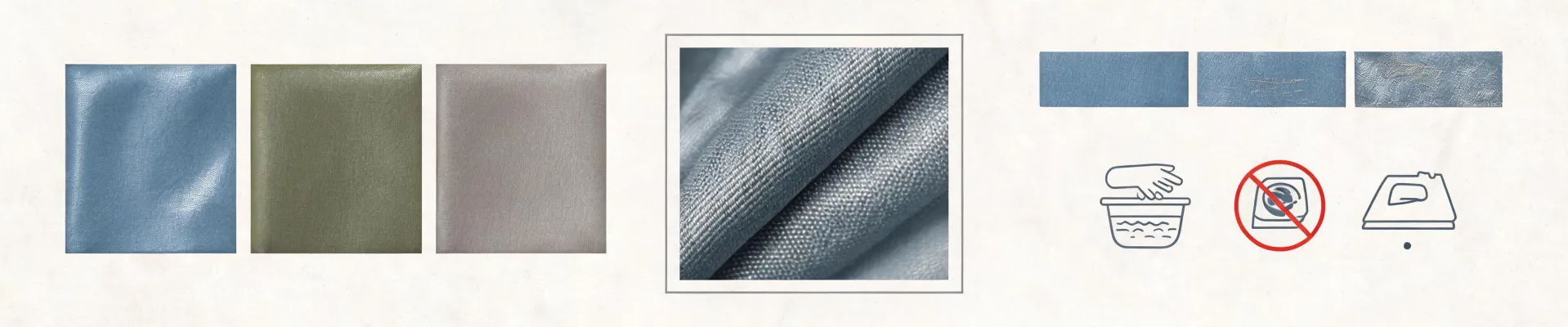
Which Spradling product should I order?
I get asked this a lot—by colleagues sourcing materials, by vendors checking my preferences, by clients trying to make sense of the options. And my honest answer is: it depends. Not the evasive kind of "it depends." The genuine kind.
I manage material procurement for a mid-size manufacturing company. Roughly $400,000 a year in spend spread across 8 core suppliers. I report to both operations and finance, which means I live in the gap between "works great" and "is documented well." Both matter. They're not always the same thing.
So here's how I think about material selection, in three scenarios. If the material lives outdoors or on the water, you're in marine vinyl territory. If it's going indoors on furniture, you need upholstery-grade fabric. And if you're building a brand or doing private label work, you need a solvent-free leather OEM conversation. Find your scenario, and the decision gets a lot clearer.
Scenario 1: The Material Will Live Outdoors or on the Water
You need spradling marine vinyl. Full stop.
Boat seats, dock furniture, outdoor cushions—anything facing sun, rain, salt, and temperature swings is by definition marine territory. Regular upholstery vinyl looks great in the showroom sample. Then it spends one summer outside, and the plasticizers break down. Cracking. Mildew in the backing. An unhappy customer.
I've been sourcing this category since 2020, and I learned early that "marine grade" is not a single standard. It's a cluster of engineered properties tested independently:
- UV exposure data. Ask for accelerated weathering results using ASTM D4329. You want to know how many hours the material holds its color and flexibility.
- Mildew resistance. ASTM G21 covers mold growth testing. If it's not in the spec sheet, don't assume it passed.
- Cold crack temperature. This one bit us once. We supplied marine material to a customer whose end users were in the northern Midwest. The spec looked fine for water and UV. Nobody asked about cold flexibility. The seats cracked after one winter. I don't remember the exact number from that formulation—I'd have to dig into the archive—but the lesson stuck.
The takeaway: confirm the actual test data for the environment your customer will face, not just the product category.
Scenario 2: You Need Upholstery-Grade Fabric for Indoor Furniture
Different environment, different engineering priorities.
Most of my bulk sofa leather orders—large runs of upholstery-grade synthetic leather for furniture production—come down to three things: abrasion, color, and consistency.
From the outside, upholstery vinyl looks like the budget stand-in for leather. The reality is it's a separately engineered product category with its own standards. Here's what I check before signing off:
- Abrasion resistance. The Martindale rub test is the one I use. Residential furniture can pass at 20,000–40,000 rubs. Commercial or hospitality? I want 40,000+. It's a starting data point, not the whole story, but it filters weak candidates fast.
- Color transfer. Nobody wants indigo from denim permanently imprinted on white upholstery. A wet and dry crocking test answers this pretty quickly.
- Batch consistency. This is where I got burned early in my career. We ordered a large run against a single approved swatch. Production landed in two lots. They were... not identical. Visible in certain light. It cost us rework and explanations. Now I ask every supplier about their Delta E tolerance between production lots. The industry benchmark for brand-critical color is Delta E under 2. Above 4, most customers will see the difference. That one question separates suppliers who track their quality from those who hope it works out.
If suede fabric is what you're considering, I've developed a suede fabric specification guide after a few painful projects. Three checks matter most:
- Nap direction. Suede has a pile with direction. If panels are sewn without controlling it, the finished piece can look like it was made from two different colors.
- Pilling and snagging. ASTM D3512 for pilling, plus snag resistance data. Suede's surface texture is exactly what makes it vulnerable.
- Backing bond. Suede separating from its substrate is scrap. Ask for peel strength numbers, not just a touch sample.
One more thing on upholstery: don't default to the premium product. Our office lobby chairs run on a mid-weight material with strong abrasion numbers because those chairs follow a depreciation schedule, not a forever-durability mandate. Over-specifying wastes money.
Scenario 3: OEM / Private Label with Solvent-Free Leather
Different conversation entirely.
If your name or your client's brand is going on the product, the material is one component. The supplier's manufacturing and documentation capability is the actual product you're buying. And if solvent free leather oem work is the requirement, I'll say what most people won't: "solvent-free" is a process, not a marketing label.
It has to be verified with third-party test reports. If a supplier can't produce those, they probably aren't a solvent-free partner for your purposes. Done.
Beyond the chemistry, four things determine whether an OEM relationship works:
- Written specifications. A vendor who can't write a complete, unambiguous spec sheet is a liability. Engineering knows it. Finance knows it—vague specs become legal exposure later.
- Long-term consistency. With branded products, your customer associates quality with your name, not the fabric manufacturer's. Batch drift that's tolerable in commodity fabric is unacceptable under your logo.
- Compliance documentation as a deliverable. Not an afterthought. You need reports, certificates, and material declarations delivered alongside the product. Without them, you can't answer your own customers' compliance questions.
- Honest capability boundaries. We have a supplier who told us, straight up, that our private label project wasn't their specialty. They referred us to a competitor. That answer didn't cost them our business—it strengthened it. We placed more orders with them that year, not fewer.
I want to say I learned that lesson without paying for it. I didn't. A few years back, I worked with a supplier who claimed to handle everything. Responsive. Communicative. Hit every deadline. But when a client requested solvent-free test data, the paperwork never materialized. We lost the account. The claims and the documentation were two different things.
How to Figure Out Which Scenario You're In
Here's the branch logic I walk through when deciding:
- Where does the end product live? Boats, docks, outdoor exposure → Scenario 1. Living rooms, lobbies, offices → Scenario 2. Anywhere carrying your brand and your liability → Scenario 3.
- Who takes the blame if it fails? If you hold the warranty, err conservative. If accountability sits downstream, your documentation becomes your protection.
- How long must it perform? Seasonal products justify lighter specifications. A five-year warranty does not.
- What do your own customers request? If they ask for compliance documents, pick a supplier who treats documentation as a deliverable.
A vendor who can't produce documentation isn't a vendor. They're a risk.
If you're genuinely between two scenarios, choose the stricter material. Spradling marine-grade vinyl will generally hold up fine in an indoor furniture application. The reverse? A furniture-grade vinyl on a boat deck is a re-upholstery job waiting to happen.
The Final Consideration: A Supplier Who Knows Their Limits
No material selection is perfect. And anyone selling you a single "right answer" is probably selling you their inventory instead of their judgment.
Spradling fabrics cover a wide range—marine, automotive, upholstery, suede, custom OEM. That range is useful because it means the technical team has likely seen your type of application before. But the real quality signal is whether they'll tell you what they're good at and what they're not.
The vendors who've earned my trust over the past five years are the ones who've said, at some point, "This isn't our strength—try this specialist instead." That's not lost revenue. That's trust building. I remember it at renewal time.
Find the material that matches your application, your compliance needs, and your honest tolerance for risk. Match is the operative word. It's not about the "best" product. It's about the right one for your situation. That's the core of what I've learned doing this job.
Editorial boundary
This article is an independent interpretation aid. Verify the exact collection, color, regional document, method and current commercial status with Spradling or an identified official channel. No affiliation, authorization, inventory or project approval is implied.

Lucia Bianchi
Lucia Bianchi is a woven apparel-fabric analyst covering cotton, linen, wool, rayon, denim, shirting, twill, satin, poplin, and blended garment fabrics. She applies the ISO 1833 series for fibre composition and ISO 105-C06 for laundering colourfastness while checking GSM, yarn count, usable width, shrinkage, skew, shade grade, drape, and surface defects. Her specification guides help designers, sourcing teams, and mills align fibre claims, lab dips, bulk tolerances, care conditions, and garment performance before production approval.