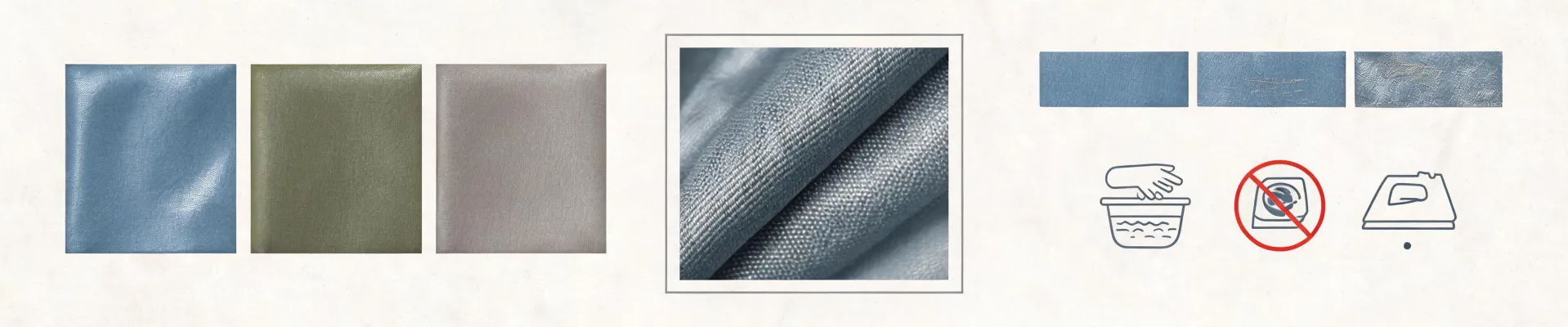
I'm not a materials scientist. I'm the person who gets called when a customer says "I need marine vinyl" or "I'm looking for solvent-free leather for a wholesale line." Since I took over purchasing in 2020, I've spent a lot of time comparing products like Spradling marine vinyl with newer alternatives like solvent-free PU leather.
Here's the one-sentence version: Spradling is a proven vinyl / synthetic leather manufacturer. Solvent-free PU leather is a broader category with cleaner chemistry claims. You shouldn't pick one until you compare them on four dimensions.
Let me walk you through those dimensions—the way I'd talk through a sourcing decision with our sales team.
Dimension 1: Performance Envelope (Vinyl vs. Solvent-Free PU)
Start with the physical environment. That's the biggest difference.
Spradling marine vinyl is built for water, sunlight, and the occasional careless dock post. In marine seating, boat upholstery, and outdoor furniture, that matters. It has a proven track record for abrasion resistance, mildew resistance, and colorfastness. I want to say that's mostly due to the cross-linked topcoat, but don't quote me on the chemistry—I just know it holds up.
Solvent-free PU leather feels softer, breathes better, and has a more natural leather-like hand feel. That's why you see it in indoor furniture, automotive interiors, and some accessories. But here's the surprise: "solvent-free" is about the manufacturing process, not about durability. A solvent-free PU can be great for a chair that sits in a living room, and a poor choice for a boat that lives in Florida sun.
So when a customer asks "which is stronger?" I answer with another question: "strong enough for what?" (unfortunately, that's not the answer they want).
Dimension 2: Compliance and Documentation
This is where I sound like the boring person in the meeting. I'm okay with that.
A wholesale order isn't just about whether the material looks good in a sample book. You need documentation. For upholstery, ask about CAL TB 117-2013, UFAC, and abrasion data. For marine, ask about flammability and water resistance testing—depending on the end use, IMO-related tests or NFPA 701 may come up (as of early 2026, at least). A good manufacturer can share third-party test reports. A good distributor should be able to connect you to them.
Spradling, because they manufacture coated fabrics at scale, has specs and test data across their lines. That doesn't mean every solvent-free PU distributor doesn't have data—it means you need to ask for it. "Eco-friendly" is not a spec.
Let me rephrase that: "solvent-free" is a manufacturing claim. "Safe for all applications" is a sales claim. Don't mix them up.
Dimension 3: Sourcing and Wholesale Supply Chain
This is the part that most product comparison guides skip. In my world, the material is half the decision; the supplier process is the other half.
When I look at Spradling, I'm looking at a manufacturer with established marine, upholstery, and automotive lines. That matters for wholesale leather fabric sourcing because consistency is the whole game. Dye lot differences, backing variations, and availability issues become expensive when you're ordering by the roll—or by the container.
When I use a PU leather distributor, I want them to be transparent about who makes the material and where. A good distributor will tell you. A not-so-good distributor will say "it's the same as the expensive brand" (guess how that usually ends).
Here's something I learned in our 2024 vendor consolidation project: If you're buying under your own label, ask about OEM or private label support early. Spradling does private label / OEM programs, which is a plus if you want your brand on a roll of marine vinyl. If you're buying direct from a manufacturer, confirmation of this is easier. If you're buying through a distributor, middleman margins and minimums change the math.
From the outside, wholesale sourcing looks like simply picking a product. The reality is you're also selecting the supplier's processes, lead times, and problem-solving ability. That was the hard lesson. It took me about 150 orders to realize that a vendor's spec sheet is less important than their ability to answer a tough question without disappearing.
Dimension 4: Cost, MOQs, and Total Order Math
I can't give you a price sheet here. Prices change too much, and they depend on quantity. What I can tell you is how to calculate total cost. (I think this is the most valuable thing I've learned in five years of sourcing.)
The quote price per yard is only one line. You need to add:
- Freight and handling
- Minimum order quantity (MOQ) effect—do you get a discount at 500 or 1,000 yards?
- Testing or certification samples, if the customer requires them
- Lead time and whether "standard" lead time is actually acceptable
- Rejection/warranty cost if the material fails—nobody puts that in the spreadsheet
I've seen the same product from two sources quote differently by 15%, and the cheaper one ended up costing more when the dye lot didn't match and we had to reorder. The question everyone asks is "what's your price?" The question they should ask is "what's included in that price?"
Solvent-free PU leather can be a very reasonable wholesale option, especially for indoor furniture and automotive aftermarket. But if you assume that "solvent-free" means lower cost and "vinyl" means obsolete, you're working from the wrong map.
So How Do You Choose Solvent-Free Leather for Wholesale?
When a client asks me how to choose solvent-free leather for wholesale, I start with the application, not the sample book. There's no single answer, but there is a process. Here's how I would think about it.
Choose Spradling marine vinyl or a proven coated fabric when:
- The end use involves water, sun, high humidity, or repeated cleaning
- You need established manufacturer specs and third-party test data
- You're sourcing marine or outdoor upholstery at wholesale scale
- You value long product history over "newest material" claims
Explore solvent-free PU leather when:
- You need a more leather-like feel for indoor furniture or automotive interiors
- Your customer specifically asks for low-VOC or solvent-free materials
- You've confirmed the performance requirements with the factory or distributor
- You're willing to do the due diligence on testing and compliance yourself
And for leather fabric sourcing in general: don't start with "which is better." Start with "what exactly does the end customer need?" Then compare Spradling fabrics, solvent-free PU leather, and the other materials in that context. An informed customer asks better questions and makes faster decisions. I'd rather spend ten minutes explaining the difference than deal with mismatched expectations later.
One last practical tip: when you talk to a PU leather distributor, bring the application with you. If you say "I need a solvent-free leather for wholesale," they should ask you about substrate, backing, rub resistance, and compliance—not just show you the swatches. If they don't ask questions, that's a red flag.
And if you're comparing it against Spradling marine vinyl, ask both sides for the same three things: physical properties by test method, compliance documents, and a reference from a customer who uses it the way you do. That will tell you more than any "best material" blog post.
Editorial boundary
This article is an independent interpretation aid. Verify the exact collection, color, regional document, method and current commercial status with Spradling or an identified official channel. No affiliation, authorization, inventory or project approval is implied.

Lucia Bianchi
Lucia Bianchi is a woven apparel-fabric analyst covering cotton, linen, wool, rayon, denim, shirting, twill, satin, poplin, and blended garment fabrics. She applies the ISO 1833 series for fibre composition and ISO 105-C06 for laundering colourfastness while checking GSM, yarn count, usable width, shrinkage, skew, shade grade, drape, and surface defects. Her specification guides help designers, sourcing teams, and mills align fibre claims, lab dips, bulk tolerances, care conditions, and garment performance before production approval.