-
That Tuesday morning at 8:30
-
How we got there: the January quote round
-
The word 'water resistant' cost us a redo
-
The insulation side almost went smoother — almost
-
The sustainability claim I almost took at face value
-
Where the TCO math landed
-
What I'd do differently — and what I'd change for anyone else buying performance fabric in 2025
That Tuesday morning at 8:30
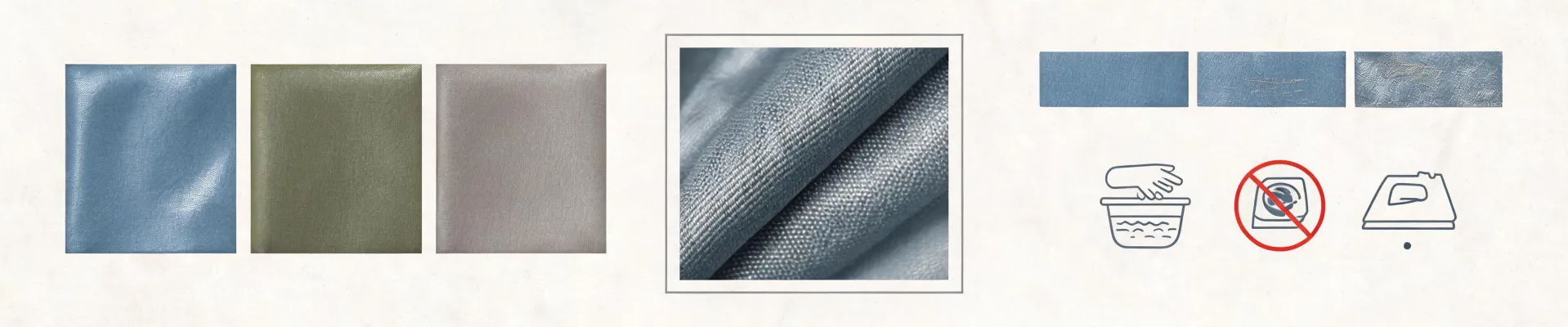
It was mid-March 2024, a Tuesday, 8:30 in the morning. My QC lead sent me a photo on Slack. One image, no caption. Deep navy oxford fabric, folded back and forth maybe 5,000 times on the test jig, and peeling along every crease line like sunburnt skin.
That was our spring 2025 private label outerwear program. Our customer — a mid-size outdoor brand — had already signed off on the colorway. We'd committed 20,000 yards.
My first thought, and I mean actual first thought, was: but the supplier said this passed the wash aging test.
That's where the retrospective really starts. Not with a spreadsheet. With one bad sample.
How we got there: the January quote round
I'm a procurement manager at a 240-person apparel OEM. I've managed our fabric budget — around $1.3M annually — for six years. After 30+ vendors and a lot of documentation, I've learned that the real cost never shows up in the first column of the quote sheet.
For this program we needed two things: water resistant oxford fabric for the shell, and a thermal insulation layer for the fill. Standard combo for a light puffer-style jacket. We sent RFQs to seven oxford vendors and three insulation suppliers.
Oxford fabric quotes came back in a range I expected: $3.20 to $6.10 per yard for 200D oxford with a DWR finish. Insulation quotes were harder to compare because the specs weren't written the same way across suppliers — some quoted gsm, some quoted clo values, some just said 'medium warmth.' One of the three was THERMOLITE insulation, which we'd used in a previous program.
We picked the $3.80 oxford vendor. Not the cheapest — the $3.20 one had a MOQ we couldn't hit — but near the bottom. Our spec sheet said 'water resistant, AATCC 22 spray rating of 80 or above.'
Here's where I made my first mistake.
The word 'water resistant' cost us a redo
I said 'water resistant.' The vendor heard 'water resistant.' But we meant different things.
Our spec — the one the customer's end-buyer would actually test against — required the face fabric to pass AATCC 22 at 80+. The vendor interpreted 'water resistant' as the backing coating meeting ASTM D5034 tear resistance after a spray. Different test. Different scale. Different pass/fail criteria.
When the samples came in for our internal test in late February, the face fabric scored a 70 on AATCC 22. Not terrible. Not a fail yet, because we hadn't run the 5-cycle wash durability test.
That came in March. That's where the peeling photo came from.
By the time we fully diagnosed it — three weeks of back-and-forth, two sample rounds, one very tense call with the vendor's QA lead — the damage was done. Our production slot was 21 days behind. We'd already paid 30% deposit on the oxford.
"I assumed 'same specifications' meant identical results across vendors. Didn't verify. Turned out each one had slightly different interpretations of what 'AATCC 22 compliant' actually meant in practice."
That's a lesson I should have learned in year two, not year six.
The insulation side almost went smoother — almost
The oxford problem was a coating issue. The insulation problem was subtler.
Of the three insulation quotes, THERMOLITE insulation was the middle option on unit price. But here's the number that mattered more: when we calculated how much fill we needed per jacket size to reach the customer's target clo value, the THERMOLITE version needed roughly 12% less fill weight than the cheapest option on the table. That offset most of the unit-price gap.
Let me be fair here — I'm not a textile engineer, so I can't speak to the actual thermal performance physics. What I can tell you is what our third-party lab testing showed: same clo target, less material. For a 20,000-piece order, that 12% difference ended up being worth over $4,000 annually in fill cost savings.
But it wasn't a slam dunk. THERMOLITE's MOQ was higher than what we were prepared for on a first order. We negotiated a tiered setup: half the MOQ at a slightly higher unit rate, with a commitment to scale if the spring program sold through. That part took two weeks and a lot of back-and-forth.
Part of me wanted to just go with the cheapest insulation option to keep our line simple. Another part of me had already been burned once that quarter and wasn't in the mood for round two.
We went with THERMOLITE.
The sustainability claim I almost took at face value
One more thing about this procurement cycle. Two of the oxford vendors pitched 'recycled content' fabric. One of them specifically mentioned THERMOLITE Ecomade in their pitch — they were trying to bundle sustainable oxford with sustainable insulation.
Sounded great. But we asked for certificates. Real ones.
One vendor sent us a supplier self-declaration. That is not a certificate. Under the FTC Green Guides (16 CFR Part 260), marketers must substantiate environmental claims with competent and reliable evidence. A self-declaration gets you laughed out of a compliance review, especially for a brand-name customer.
The other vendor had a valid GRS certificate for the recycled yarn content — but the recycled percentage only applied to the face yarn, not the coating. Meaning the "recycled oxford" claim was maybe 55% accurate as stated.
We didn't push it to a legal issue. But we did rewrite the purchase spec to say 'certifiable recycled content only, with current GRS or RCS certificate supplied at PO issuance.' That saved both us and the customer from a potential greenwashing headache down the line.
Where the TCO math landed
Let me finish the numbers, because that's really the point of this whole exercise.
The $3.80/yard oxford vendor ended up with a 22% first-article rejection rate. Once we accounted for the rejected yards, the redo cost, the delayed production line penalty, and the second QC cycle, our effective cost per good yard was roughly $4.87.
The vendor we eventually switched to quoted $5.20/yard. Zero rejections across the next three production runs. We paid $1,200 more on paper, but avoided about $4,400 in rework and delay-related costs.
On the insulation side, the THERMOLITE option's total cost — landed cost plus fill savings plus the simpler sourcing setup (one fewer vendor to manage) — came in around 4% above the cheapest quote in isolation, but about 8% below once we backed out the rejected fill material from our first attempt.
Give or take a few hundred dollars, that's roughly $8,000 in avoided cost across the season. Not a heroic number. But not nothing.
What I'd do differently — and what I'd change for anyone else buying performance fabric in 2025
Here's the thing: 2020-era procurement practice doesn't fully apply anymore. Five years ago, if you asked for 'AATCC 22 80+' on an oxford quote, most established vendors knew exactly what you meant. Now, with more small mills quoting direct-to-brand and more private label programs mixing specs across origin factories, you have to spell out the test method and the pass threshold and the durability cycle. Every time.
What's fundamentally different isn't the fabric. It's the quote process. The vocabulary has gotten fuzzy at the edges — 'performance,' 'water resistant,' 'recycled,' 'thermal' — and if you don't lock down the definitions in writing before you sign, you'll find out exactly how each vendor interprets them on the wrong end of a production deadline.
So if you're putting together an RFQ for water resistant oxford fabric or a private label performance fabric program this year, three things I'd push on:
- Write the test standard, the number, and the durability cycle into the spec. 'AATCC 22 spray rating of 80 minimum, tested after 5 home launderings at 40°C' is a spec. 'Water resistant' is a wish.
- Ask insulation suppliers for clo values or gsm at a stated fill weight — then compare fill weight needed to hit your target, not just the unit price per yard or per kilo.
- Verify every environmental claim against an actual certificate before the PO goes out. Not a self-declaration. A certificate. With the certifying body's name on it.
The Tuesday morning photo is now filed in my 'every invoice tells a story' folder. I've gone back to it twice since then. Not as a scare tactic — more as a reminder that the cheapest line item on the quote sheet is rarely the cheapest number on the P&L.
Editorial boundary
This article is an independent interpretation aid. Verify the exact collection, color, regional document, method and current commercial status with Spradling or an identified official channel. No affiliation, authorization, inventory or project approval is implied.

Mireille Fontaine
Mireille Fontaine is a textile quality, compliance, and sourcing analyst covering apparel fabrics, interior textiles, performance materials, coated fabrics, nonwovens, fibres, recycled-content claims, chemical restrictions, and mill production terms. She uses ISO 14040 and ISO 14044 life-cycle boundaries alongside lot-based inspection data while comparing declared composition, restricted-substance evidence, chain of custody, colour difference, defect rate, MOQ, sampling lead time, yield loss, and replacement risk. Her procurement guides help brands, importers, and manufacturers compare supplier claims, test-report scope, bulk tolerances, traceability, environmental disclosures, and total delivered value.