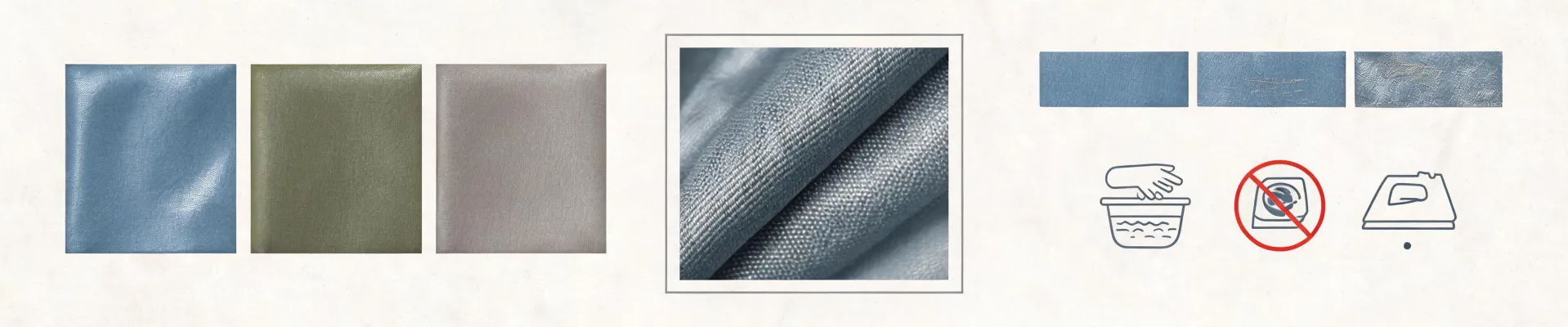
I run quality and brand compliance for a mid-size upholstery operation. Roughly 200+ incoming rolls a year pass through my table before anything reaches a customer. In our Q1 2024 audit, I rejected close to 18% of first deliveries—not because anyone was acting in bad faith, but because the spec sheet and the physical roll weren't describing the same thing.
Here's what I've learned the hard way: there is no single "right" faux leather to specify. Depending on whether you're a two-person shop testing 15 yards of Spradling marine vinyl or an OEM locking in a quarterly automotive leather distributor contract, the answer changes completely. So I'm not going to give you one answer. I'm going to split this into three scenarios, and then help you figure out which one you're actually in.
The Three Scenarios—Quick Map
Before the details, here's the classification I use:
- Scenario A: Small-batch / trial order. Under ~50 linear yards, often from a one- or two-person shop, evaluating whether a material is even right.
- Scenario B: Branded production run. You have a spec, a customer-facing label, and a mid-to-large order where consistency across rolls matters more than the price of any single roll.
- Scenario C: Silicone or premium-spec sourcing. You're buying silicone leather wholesale, or you need a specific performance profile (abrasion, hydrolysis, UV) that PVC-based vinyls can't match.
Most buyers don't fit neatly. If you're a small shop buying for one boat, you're in A. If you're an OEM sourcing for a boat builder's full line, you're in B, possibly C. If you're somewhere in between, read the judgment section at the end first.
Scenario A: Small-Batch and Trial Orders
Let me get my bias out of the way. I have a real problem with suppliers who treat a 20-yard order like an inconvenience. When I was starting out, the vendors who took my $200 orders seriously are the ones I still buy from for $20,000 orders today. Small doesn't mean unimportant—it means potential.
That said, small-batch buying has real tradeoffs, and pretending otherwise doesn't help you.
What to expect: higher per-yard pricing (it's not discrimination, it's dye-lot economics), longer lead times on non-stock colors, and—this is the big one—dye-lot variance. If you buy 15 yards today and 15 more in six weeks, they may not match exactly. For a small project, this rarely matters. For anything visible side by side, it does.
What to specify: ask for the current dye lot number in writing. If they can't or won't give it, note that for your next order. Get a physical sample swatch, not just a digital one—screen calibration lies, and marine vinyl in particular reads very differently outdoors than on a monitor. Spradling Breeze, for example, has a matte surface that photographs flatter than it looks in person; I've seen people order based on a photo and be surprised by the sheen.
The pitfall I hit: I once skipped the physical swatch step on a small order because the digital sample looked fine and the vendor was reputable. It was Spradling marine vinyl in a beige tone. The actual roll came in slightly warmer—closer to cream. On a 15-yard order for a helm chair rebuild, it was fine. It would not have been fine on a 40-piece run. I knew I should get the swatch. I thought, "what are the odds?" The odds caught up.
Red flag: a supplier who can't tell you the dye lot, the current test data, or the intended end-use (marine vs. automotive differ in UV and hydrolysis requirements). If they brush off the question, that's information.
Scenario B: Branded Production Runs
This is where the spec sheet earns its keep. Once your name is on the product, a material that "looks close enough" becomes a returned shipment.
For branded runs—upholstery lines, boat interiors with a house brand, private-label automotive seating—I require the following in every production contract:
- Dye-lot hold. The vendor reserves a specific lot for the duration of the run. If they can't hold it, we split the run across lots and test first.
- Physical spec acceptance. Thickness, weight per square yard, tensile, tear, and elongation—measured per roll, not per shipment. Batch averages hide individual roll drift.
- Test method callout. "Meets MVSS 302" means nothing without the test lab and date. I've started requiring that the automotive leather distributor supply the actual test report PDF for the exact lot, not a generic certificate from 2022.
- Color matching under defined light. I use a light booth set to D65. Two materials that match under office lighting can diverge under daylight. This is where a lot of Spradling Breeze vs. generic marine vinyl disputes come from—Breeze holds color better under UV, but the initial match still needs verification.
Satisfaction moment: after two years of arguing with vendors about whether a roll "looked close enough," we finally wrote a one-page spec acceptance sheet. Rejections dropped by more than half. There's something satisfying about a problem that stops being a problem. The best part: I stopped getting 8pm calls about color.
The overconfidence fail: In late 2023, we had a rush run and I skipped the per-roll tensile check on the first two rolls because the shipment was on schedule and the last six from this vendor had been clean. Roll three failed elongation by a noticeable margin. We caught it before cutting—by luck, not by process—but it cost us four days and a partial re-ship. The lesson wasn't "never trust vendors." It was "never skip the check because you're busy."
Scenario C: Silicone Leather Wholesale and Premium Specs
This is the scenario most guides skip, and it's the one where the wrong spec choice gets expensive fast.
Silicone leather sits in a different performance class than PVC-based vinyl. Real silicone surfaces resist hydrolysis, hold up against certain chemical exposures, and—critically—don't off-gas plasticizers the way PVC vinyls can. That last point matters more than people realize. In a hot car interior in July, PVC vinyl can fog the windshield over time. Silicone doesn't, or does so much less that it stops being the deciding factor.
When is silicone worth the premium? My honest answer, based on what I've sourced: when the end-use conditions are genuinely harsh—direct sun exposure, chemical contact, or a lifespan expectation beyond 5-7 years. For a standard booth seat at a restaurant, PVC-based vinyl is fine and the silicone premium is wasted money. For a yacht tender that lives outdoors, it's not.
What to watch in silicone leather wholesale:
- Confirm whether the substrate is actually silicone or a silicone topcoat over a different base. These are sold with similar language and are very different products.
- Ask for the abrasion test method (Martindale cycles @ specific pressure, or Wyzenbeek, rub count). "High abrasion resistance" without a number is marketing.
- Verify the backing. Silicone face on a weak knit backing will fail at the backing before the face wears.
Regret-to-relief moment: I almost ordered a cheaper silicone-look PVC for a marine use once to save roughly a third on the roll. Then I actually read the spec: hydrolysis rating was fine on paper, but the UV hold was rated for interior use only. We went with the real silicone. Roughly $900 more on the run. Would've been a much more expensive conversation with the customer two summers later.
How to Know Which Scenario You're Actually In
Now the part that matters. Answer these honestly:
- Is the material going to a customer under your name? If yes, you're in B (or C if the specs are premium). If the material is for testing, personal use, or an internal prototype, you're in A.
- Will the end user see this material next to an identical piece two years from now? If yes, you need dye-lot hold and UV stability—that pushes you from A toward B, and often from B toward C.
- What's the exposure environment? Indoor, temperature-controlled, and low-friction? A standard PVC marine or upholstery spec is fine. Outdoor, high UV, chemical contact, or extreme temperature swings? That's silicone or a top-tier marine vinyl with documented test data—not a budget equivalent.
- What's your tolerance for a redone run? If the answer is "zero, it would kill the project," then you already know: pay for the spec work upfront. In my experience, the money saved on skipping spec verification is consistently less than the money spent fixing what the spec would have caught.
One more thing I should mention. Ask your supplier for their last two failed-batch reports. Not their marketing data—their failures. The vendors who can show you a failure trend analysis and how they fixed it are the ones I trust with 12-month contracts. The ones who've "never had a problem" usually mean they've never looked.
You're not looking for a material that never fails. You're looking for a supplier who's already thought about how it could. That's the whole game, whether you're buying 15 yards of Spradling Breeze or a container of silicone leather wholesale.
Editorial boundary
This article is an independent interpretation aid. Verify the exact collection, color, regional document, method and current commercial status with Spradling or an identified official channel. No affiliation, authorization, inventory or project approval is implied.

Beatriz Costa
Beatriz Costa is an outdoor and performance-fabric analyst specializing in waterproof shells, breathable laminates, ripstop, nylon and polyester oxford, tent cloth, backpack fabrics, awnings, and solution-dyed textiles. She uses ISO 811 hydrostatic-pressure and ISO 13937-2 tear methods while tracking water resistance, tear force, moisture-vapour transmission, air permeability, coating adhesion, UV colourfastness, abrasion, and low-temperature flexibility. Her technical comparisons help outdoor brands, converters, and equipment manufacturers balance protection, breathability, durability, packability, seam construction, and climate exposure.