-
1. Start with the application, not the price
-
2. Request samples and run your own tests
-
3. Calculate total cost of ownership (TCO)
-
4. Check compliance and environmental claims
-
5. Evaluate supplier support and small-order friendliness
-
6. Watch for the surface illusion
-
What about automotive leather catalogs?
-
Boundary conditions: when this advice doesn't apply
The best wholesale sofa leather isn't the one with the lowest price per yard. It's the one with the lowest total cost of ownership—and for many B2B buyers, Spradling is worth a serious look. I've seen quotes that looked 20% cheaper on paper end up costing 35% more after freight, defect returns, and expedited replacements. If you're sourcing faux leather for sofas, marine upholstery, or automotive interiors, focus on TCO, not unit price.
I'm a procurement manager at a 45-person furniture manufacturer. I've managed our upholstery fabric budget ($180,000 annually) for six years, negotiated with 12+ faux leather suppliers, and documented every order in our cost tracking system. In Q2 2024, when we switched vendors, we saved $8,400 annually—17% of our fabric budget—but only after we standardized how we calculated TCO.
Spradling is a faux leather supplier that covers a lot of ground: marine vinyl, residential upholstery, automotive, and contract furniture. Their product range includes Spradling marine vinyl (known for UV and mildew resistance) and Spradling Breeze, a breathable synthetic leather often used in seating. They also publish an automotive leather catalog with products that meet common flammability specs like FMVSS 302. For OEM/private label buyers, they support batch supply and custom specifications.
But here's the catch: no supplier is right for every project. You need to match the material to the application. A sofa for a hotel lobby has different requirements than a boat seat or a car interior.
1. Start with the application, not the price
Marine vinyl needs UV stabilizers, mildew resistance, and cold-crack resistance. Automotive leather must pass flammability and fogging tests. Sofa leather for wholesale needs abrasion resistance (Wyzenbeek or Martindale) and colorfastness. Spradling marine vinyl is a good starting point for wet environments. Spradling Breeze is better for indoor upholstery where breathability matters. The automotive leather catalog is a separate beast—don't assume a sofa fabric will pass automotive specs.
2. Request samples and run your own tests
Most buyers focus on the spec sheet and completely miss real-world performance. I learned this the hard way. In 2023, we approved a faux leather based on a vendor's in-house abrasion data. Within six months, we had a 12% defect rate on a hotel sofa order. The backing delaminated. That cost us $1,200 in rework and a lot of goodwill.
Looking back, I should have paid for third-party abrasion testing upfront. At the time, the vendor's in-house data seemed sufficient. It wasn't.
Now we require every new faux leather supplier to send a 1-yard sample. We test abrasion, flex, and adhesion in-house. If they won't send a sample without a large order, that's a red flag.
3. Calculate total cost of ownership (TCO)
Unit price is just the beginning. Here's the TCO formula I use:
- Material cost per yard
- Freight and duties
- Minimum order quantity (MOQ) penalties—what happens if you need less?
- Lead time and expedited shipping costs
- Defect rate and return/replacement costs
- Storage and handling
- Compliance testing (if not provided)
In 2024, I compared two faux leather suppliers for a 2,000-yard sofa order. Supplier A quoted $8.50/yard. Supplier B quoted $6.75/yard. I almost went with B until I calculated TCO. B charged $450 for setup, $300 for a pre-shipment inspection, and had a 7% defect rate that required returns. A's $8.50 included everything and had a 1.5% defect rate. Total cost: A was 12% cheaper. That's a $2,800 difference hidden in fine print.
4. Check compliance and environmental claims
Per FTC guidelines (ftc.gov), any performance claim—like 'marine-grade' or 'automotive-safe'—must be truthful and substantiated. If a faux leather supplier claims 'eco-friendly' or 'recyclable,' ask for specifics. The FTC Green Guides (16 CFR Part 260) require that recyclable claims be backed by evidence that recycling facilities are available to at least 60% of consumers where the product is sold.
I'm not a chemist, so I can't speak to the exact plasticizer migration or VOC content. What I can tell you from a procurement perspective is: get the test reports. Don't accept 'it meets all standards' without a certificate.
5. Evaluate supplier support and small-order friendliness
Here's a stance I'll defend: small orders shouldn't be discriminated against. When I was starting out, the vendors who treated my $200 sample orders seriously are the ones I still use for $20,000 orders. Small doesn't mean unimportant—it means potential.
Spradling, for example, supports OEM/private label and batch supply. But you need to ask about actual MOQs. Some distributors will work with you on trial orders. Others won't. If a supplier won't even quote a 100-yard trial, they're probably not a good long-term partner for a growing brand.
6. Watch for the surface illusion
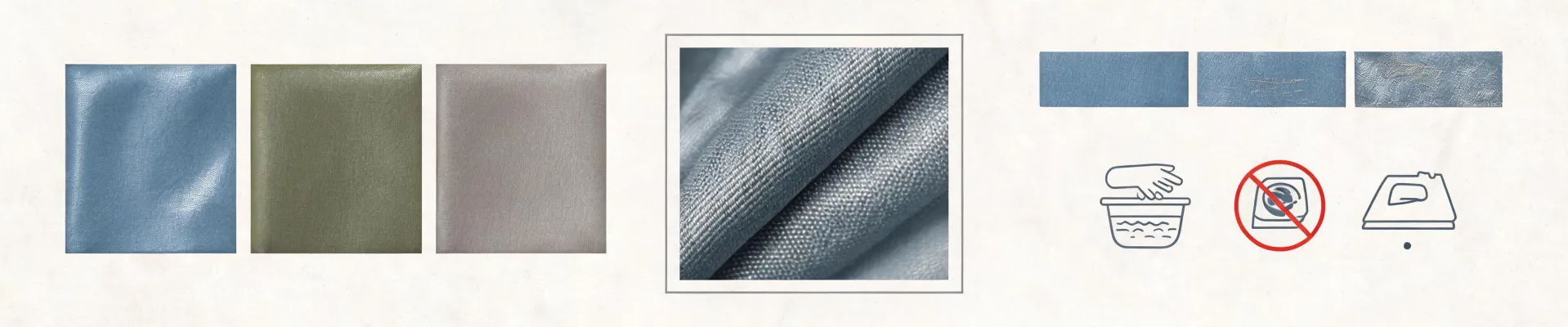
From the outside, faux leather suppliers look interchangeable. The reality is that backing, coating, and finish vary wildly—and that's where warranty claims come from. A cheap vinyl might look great in a sample book but crack after 500 double rubs. A breathable product like Spradling Breeze might be perfect for a dining chair but wrong for a marine environment.
I went back and forth between a domestic supplier with fast lead times and an overseas supplier with 25% lower unit cost. Ultimately chose domestic because our production schedule couldn't absorb 8-week delays. The unit cost was higher, but the lead time saved us two weeks of downtime—worth more than the savings.
What about automotive leather catalogs?
If you're sourcing for automotive, the rules change. Automotive leather catalogs (like Spradling's) list products that meet FMVSS 302, fogging, and abrasion requirements. Don't try to use a sofa fabric in a car. The testing is different, and the liability is real.
For wholesale sofa leather, stick to upholstery-grade faux leather. Check the abrasion cycle count. For commercial use, aim for at least 50,000 double rubs (Wyzenbeek). For residential, 15,000–30,000 is often enough. Spradling's upholstery line usually publishes these numbers. Verify current specs with the supplier.
Boundary conditions: when this advice doesn't apply
This isn't a one-size-fits-all guide. If you're a large OEM with a dedicated quality team, you might already have your own TCO model. If you're buying 100,000 yards annually, you have leverage to negotiate custom terms. If you're in a regulated industry like aerospace or medical, you need specialized certifications that Spradling may or may not have.
Also, this pricing was accurate as of Q4 2025. The market changes fast—resin prices, freight rates, and MOQs shift. Verify current rates before you budget. And remember: I'm a procurement manager, not a materials engineer. For final material selection, consult your technical team and request third-party test reports.
At the end of the day, choosing sofa leather for wholesale comes down to matching specs to application, calculating TCO, and working with suppliers who respect your order size. Spradling is a strong candidate for many B2B buyers—especially if you need marine vinyl, breathable upholstery like Spradling Breeze, or an automotive leather catalog. But do the math. Ask for samples. And don't let a low unit price fool you.
Editorial boundary
This article is an independent interpretation aid. Verify the exact collection, color, regional document, method and current commercial status with Spradling or an identified official channel. No affiliation, authorization, inventory or project approval is implied.

Peter Wekesa
Peter Wekesa is a textile-reinforcement and prepreg analyst covering carbon, glass, aramid and basalt fabrics, woven roving, unidirectional tapes, multiaxial reinforcements, meshes, and resin-impregnated materials. He applies ISO 4602 yarn-count methods while measuring fibre areal weight, tow size, warp and weft density, orientation, crimp, resin content, tack, out-time, storage temperature, cured thickness, and defect rate. His engineering guides help composite fabricators, construction specialists, and mobility suppliers coordinate layup design, handling limits, traceability, process windows, and incoming-material acceptance.