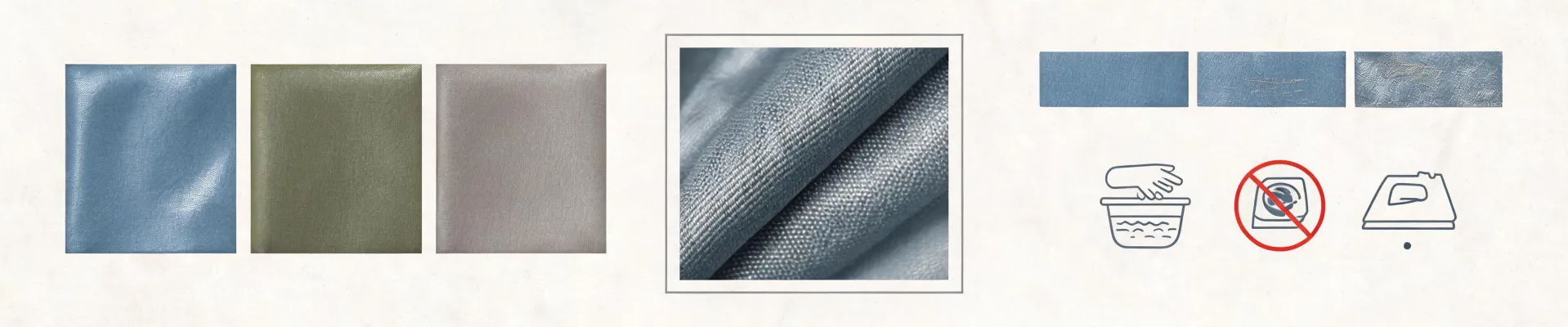
If you source faux leather in wholesale quantities, here is the most expensive lesson I can save you: buy the specification and the supplier before you buy the yard. I manage purchasing for a 40-person shop that restores marine seating, fleet vehicle interiors, and contract upholstery. I place roughly $180,000 a year in coated fabric orders, and I learned that rule by paying for bad “cheap” vinyl once. I would rather you not repeat my mistake.
I am not a materials scientist. I am the person who signs the purchase orders, checks the invoices, and explains to my operations manager why a project is late. So this guide is not theory. It is what I now check before every wholesale faux leather order.
I used to think synthetic leather was a commodity
When I first took over purchasing in 2020, I assumed faux leather was basically a commodity. Same polymer family, similar backing, different marketing. That misconception is exactly why, in 2023, I moved a 600-yard marine order to an unknown wholesaler who undercut our regular supplier by 11 percent. I saved $340 on that order.
Eight months later, the material was failing. Some panels that sat in direct sun started to craze, and the color on a few navy installs looked washed out. We pulled and replaced sixteen panels. Between labor, re-delivery, and lost time, the rework cost us roughly $2,300. I saved the company $340 and spent $2,300 to do the same job twice. That is what I mean when I say a cheap quote is not always a cheap buy.
How to choose faux leather for wholesale: read past the swatch
The next time a faux leather catalog lands on your desk, do not start with the color swatches. Start with the data behind them. A pretty card can hide a backing that will not hold a seam or a topcoat that will not survive sun exposure.
Check the backing, not just the vinyl topcoat
Coated fabrics are two products in one: a base textile and a vinyl surface. Most buyers focus on the top layer, but the backing is often what fails first. It carries the load, takes the flexing, and holds the seam. A woven backing may give you more dimensional stability. A knit backing may conform better around curved seats and contoured panels. Neither is automatically “better” — but you need to know which one fits the application. If a supplier cannot tell you what the backing is, that is an answer in itself.
Make “marine grade” mean something
The phrase marine grade describes an application, not a test. A responsible manufacturer can point to actual standards: ASTM D751 for coated fabric testing, ASTM D3690 for vinyl upholstery fabric performance, California TB 117-2013 for commercial furniture flammability, or FMVSS 302 for automotive interior flammability. You do not need to memorize every clause. But ask for test data in writing. When you ask a supplier about their marine vinyl specification and they say “we don’t publish that,” the risk has quietly moved to your shop.
Color control is a supply chain issue
A swatch card makes every color look stable. In reality, vinyl color varies between production lots. If you are supplying seating for boats, vehicles, or an office project, a mismatched lot is not an aesthetic problem. It is a callback problem.
Ask for lot-level color data. The industry benchmark for color measurement is Delta E in the CIELAB space, often referenced against systems like the Pantone Matching System. For brand-critical colors, the common guideline is Delta E below 2. Delta E from 2 to 4 is noticeable to a trained eye, and above 4 is visible to most customers. If a supplier cannot provide color data before shipping, you are gambling on luck.
Why Spradling became our default for marine vinyl
After the 2023 rework, our shop standardized on Spradling marine vinyl for anything going into saltwater, direct sun, or heavy public use. Honestly, it is not the cheapest option. But buying from an established vinyl manufacturer gives us things a low-cost import does not: published specs, lot numbers, reliable distributors, and a phone number when something looks wrong.
On a recent wholesale order, the difference between unbranded vinyl and a Spradling line was about $0.90 per yard. That sounds like a lot until you multiply it by what can go wrong. One service callback eats that savings. One late shipment delays the entire installation crew. For my employer, the premium buys a promise I can plan around.
Here is a concrete example. In March 2025, we had a rush project for 38 custom seat covers. Approval to install was only three weeks. One supplier could not commit to a delivery date beyond “probably.” The Spradling distributor gave us a written ship date, a pre-production sample, and lot-level color data in 24 hours. The order cost about $310 more. The covers went in two days ahead of deadline. That $310 was not paying for material — it was buying time certainty. I would do it again tomorrow.
Our smaller automotive leather jobs follow the same logic. Car interiors face abrasion, heat, and cleaning chemicals, so the material selection should be based on test data, not on a photo in a catalog. If I cannot see the spec sheet, I cannot defend the choice to the customer.
When the generic vinyl is actually fine
I don't want this to sound like every single project needs a premium brand. Some applications genuinely do not need marine-grade performance. If the vinyl is going into a trade-show mockup, a temporary display, a workshop prototype, or a decorative piece that will be replaced within a year, a cheaper source might be the right call. Buy the risk to match the use.
What I push back against is buying cheap vinyl for permanent, high-labor installations just because the per-yard number looks better. If someone has to cut, sew, staple, and install that material, the labor cost will always be higher than the material cost. Protect the labor with material you actually trust.
Questions to ask before placing a wholesale faux leather order
These are the questions I now ask every supplier, and you should too:
- Who is the actual manufacturer? A distributor may carry a private label, and that is fine — but the manufacturer should be named and traceable.
- Will you provide the spec sheet before I order? If it only comes after the deposit, that is a red flag.
- Which test standards does the product meet? Look for ASTM, FMVSS, California TB 117-2013, or the relevant industry equivalent.
- Can you commit to a delivery date in writing? “Probably” is not a schedule.
- Can you send lot and color data with each shipment? This is the only way to verify consistency roll after roll.
My honest bottom line
I have been burned by cheap vinyl, and I have been saved by a supplier who could prove what they sold. That experience is specific to our shop, and your risk profile may be different. If you have a low-stakes job, buy accordingly. But if the project has a deadline and the customer will notice a failure, an established name like Spradling is worth more than the invoice difference.
The cheapest vinyl is the one you can reinstall without explaining it to your boss. That is the standard I use now.
Editorial boundary
This article is an independent interpretation aid. Verify the exact collection, color, regional document, method and current commercial status with Spradling or an identified official channel. No affiliation, authorization, inventory or project approval is implied.

Lucia Bianchi
Lucia Bianchi is a woven apparel-fabric analyst covering cotton, linen, wool, rayon, denim, shirting, twill, satin, poplin, and blended garment fabrics. She applies the ISO 1833 series for fibre composition and ISO 105-C06 for laundering colourfastness while checking GSM, yarn count, usable width, shrinkage, skew, shade grade, drape, and surface defects. Her specification guides help designers, sourcing teams, and mills align fibre claims, lab dips, bulk tolerances, care conditions, and garment performance before production approval.