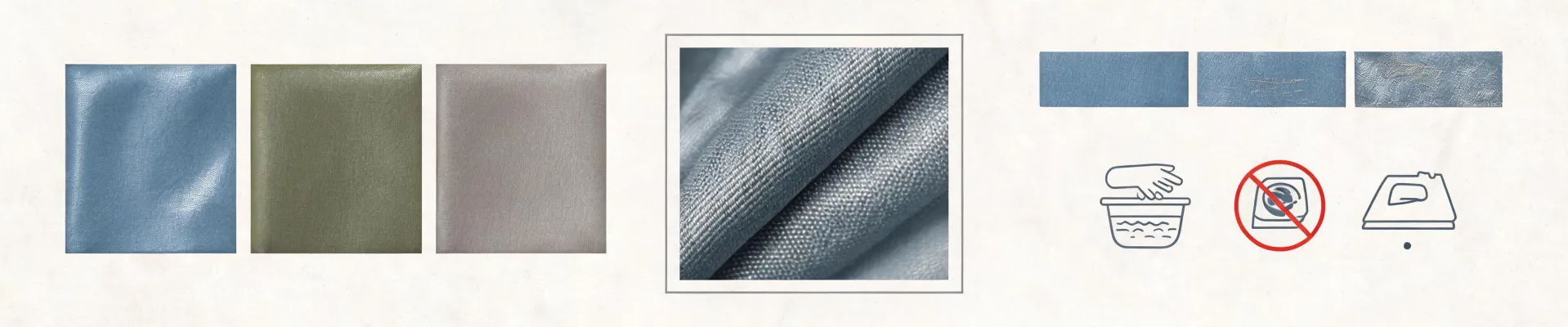
What looked like a quality problem
In 2021, I approved a hand swatch for a custom color project and ordered what the PO called 'gray marine vinyl.' The swatch looked perfect on my desk. The production roll looked close in the warehouse, but under daylight it had a purple cast the sample never showed. The supplier said their QC considered it acceptable. I said it wasn't acceptable to our customer. Nobody wanted to pay for a 300-yard mistake.
My first instinct was to blame the vendor. After a few more orders, I realized that wasn't the whole story. The vendor wasn't trying to trick us. We simply hadn't defined what acceptable meant.
If you've ever had to explain why a dye lot doesn't look like the original swatch, you know the feeling. It's not about being right. It's about a material order that should have been straightforward turning into a conversation about who owns the problem.
The first trap: category names
The first reason purchase orders go wrong is that synthetic leather is an umbrella term, not a specification.
What I mean is that a product can be called marine vinyl while being made from very different constructions. It might be a PVC-coated fabric on one type of backing or a polyurethane-coated material on another. The coating can have different UV or mildew packages. Microfiber leather is different again; it usually starts with a microfiber substrate and a polyurethane finish. If you compare quotes as if all of these are versions of the same thing, you aren't comparing products. You're comparing solutions to problems you haven't fully defined yet.
I'm not a textile chemist, and I won't pretend to be one. But an administrator can still ask: 'What is the base? Is this PVC, PU, or microfiber leather? What end use was it designed for?' If the person answering can't tell me those basics, that's a red flag. If they can, then price starts to mean something.
The second trap: samples suggest consistency
The second reason orders go sideways is that samples are treated as promises made under lab conditions.
A hand swatch is made carefully, often one at a time. A production roll is made in volume. Coating thickness, oven temperature, embossing pressure, finish application—all of those can shift between the swatch and the batch. A four-by-six sample does not warn you how a roll will behave after lamination or sewing.
Why does this matter? Because the gap between hand swatch and production is where the product actually lives. If you don't approve a production sample before the full run, you've given the supplier room to meet their standard while your standard is still just an idea in your head.
The third trap: color is a feeling until somebody measures it
The third reason, and maybe the biggest one, is color.
At first we approved colors with phrases like 'match this fabric' or 'a little darker than this chip.' Those phrases are unreliable. A physical chip fades. A monitor changes from room to room. A number does not.
According to Pantone Color Matching System guidelines, a Delta E under 2 is often used as a target for brand-critical color work. Delta E between 2 and 4 is noticeable to trained observers. Above 4, the difference is visible to almost anyone. I use those numbers as a starting point, not a magic formula. The important thing is that buyer and supplier agree on a tolerance before production, not after.
What a wrong roll actually costs
If the only cost of a mismatch were replacement material, you'd be lucky. It's not. You pay freight. You pay warehouse time. You pay rush freight for the replacement. The customer reschedules and quietly starts looking at other sources.
I remember one custom order where we ended up discounting 350 yards for roughly $3,200 below the original selling price. I want to say $3,200; I might be mixing it up with a separate freight credit. Either way, the discount was larger than the savings that had made the cheaper bid look attractive in the first place.
The most frustrating part of vendor management is that the same problems repeat with different materials. You'd think a clear email would prevent it, but email doesn't establish tolerances. Finance doesn't care about tolerance; finance cares about inventory. Operations cares about schedules. I'm stuck in the middle when nobody wrote down acceptance criteria.
What changed for me
The turning point was realizing that a roll of synthetic leather is not the real product. The real product is an agreement: construction, color tolerance, backing, finish, documents, and samples. If the agreement is vague, the material will be vague.
Now when I write a PO for a branded item like Spradling marine vinyl, I still specify the exact product line and ask for its current technical sheet. A brand can narrow the range, but it doesn't replace the specification. The same is true for Spradling vinyl in general or an OEM synthetic leather run under a customer's private label. The label doesn't make the material suitable. The construction and test data do.
The suppliers who helped the most were the ones who asked questions back. When a supplier asks what the material will be used for, whether it needs UV resistance, or how we plan to compare color, that's not an annoyance. That's the supplier doing quality control before the order exists.
The buying guide I use now
I use the same core process for a 50-yard trial order and a 5,000-yard program. The price is not the same, and the service may not be the same, but the questions should be.
- Name the construction, not just the category. Ask if the product is PVC, PU, or microfiber leather. Ask about the backing and the intended end use. If the seller can't answer, walk slowly.
- Define color with a number and a tolerance. Use a Pantone reference or a physical master sample. State the Delta E you expect to stay within, or ask the supplier to explain their color tolerance in writing.
- Approve a production sample before custom runs. A hand swatch is a starting point. A first article from the actual production process is the no-brainer that prevents expensive surprises.
- Collect the paperwork. Technical data sheet, current test reports, product name, batch number, and invoice details. My finance team will reject a handwritten receipt no matter how good the material is.
- Plan for lot variation. If a large order has to match, buy it as one lot or keep a sealed sample from the approved lot. Different production runs can be acceptable, but they need a comparison point.
Small orders are not a nuisance
One last thing. Our company places small orders all the time. A 200-yard trial is how we test a new supplier. If a supplier treats that order like a problem, they probably won't see the larger order later. Small doesn't mean unimportant; it means potential.
Does every supplier need to accept tiny lots? No. Minimums can be a real business constraint. But there is a difference between having a minimum and making a buyer feel foolish for asking. I've walked away from both.
This approach is not universal. If you're buying commodity black vinyl for a short-term display, some of this is overkill. If you're sourcing custom marine upholstery material or OEM synthetic leather that will carry your customer's name, it isn't. Context matters.
Bottom line: The problem was never the supplier who made a mistake. It was our process for describing success before we ordered. Ask the right questions, write down the answer, and require a sample from actual production. That's the closest thing I've found to a smooth procurement process.
Editorial boundary
This article is an independent interpretation aid. Verify the exact collection, color, regional document, method and current commercial status with Spradling or an identified official channel. No affiliation, authorization, inventory or project approval is implied.

Lucia Bianchi
Lucia Bianchi is a woven apparel-fabric analyst covering cotton, linen, wool, rayon, denim, shirting, twill, satin, poplin, and blended garment fabrics. She applies the ISO 1833 series for fibre composition and ISO 105-C06 for laundering colourfastness while checking GSM, yarn count, usable width, shrinkage, skew, shade grade, drape, and surface defects. Her specification guides help designers, sourcing teams, and mills align fibre claims, lab dips, bulk tolerances, care conditions, and garment performance before production approval.