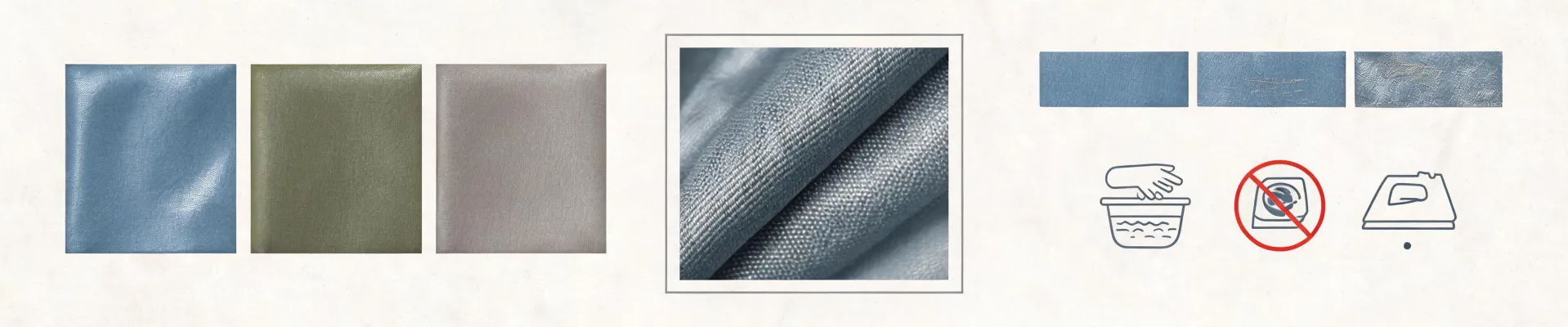
When I first moved into quality compliance for a fabric distributor, I assumed PU leather was PU leather. Same basic chemistry, same basic performance, pick whichever quote looks best on a spreadsheet. About three rejected batches and one very awkward customer call later, I realized the gap between an established brand like Spradling and a generic PU supplier isn't incremental—it's a different category entirely.
Here's what I actually compare when evaluating Spradling vinyl against generic PU leather for marine, upholstery, and automotive applications. Four dimensions, ranked by how often they cause problems downstream.
Specification Compliance: The Documentation Gap
This is where the difference hits you first, and it's the dimension I'd check before anything else.
Spradling publishes test data for every product line. For Spradling marine vinyl, you get documented UV resistance (typically tested to ASTM G154 or equivalent), mildew resistance, cold crack performance, and abrasion cycles measured to ASTM D4157 Wyzenbeek. Their Spradling Softside marine vinyl—the line a lot of pontoon builders and runabout manufacturers spec—comes with specific cold crack ratings down to -20°F and saltwater exposure data. These aren't marketing bullet points; they're test results tied to named standards.
Generic PU leather? In my experience, maybe 40% of suppliers provide anything close to that level of documentation. The other 60% send a spec sheet that says "marine grade" or "automotive quality" without a single test reference. I'm not a polymer chemist—I can't reverse-engineer a formulation from a swatch. What I can do is ask for test reports, and that's where generic suppliers tend to go quiet.
For automotive leather specifications, this matters even more. FMVSS 302 flammability compliance is non-negotiable for interior components. If your supplier can't produce a test report from an accredited lab, you're accepting risk you can't quantify. I've seen distributors eat that risk and lose a Tier 1 account over it.
In a 2024 supplier audit, we requested test documentation from 8 PU leather vendors. Three provided complete ASTM and FMVSS reports. Five provided partial or no documentation. We didn't proceed with any of the five.
Batch-to-Batch Consistency: Where Cheap Gets Expensive
Color variation between batches is the silent killer of upholstery and marine projects. Not catastrophic—just enough that a customer notices their replacement cushion doesn't quite match the original set.
Spradling's manufacturing runs tighter tolerances on color matching (typically within a Delta E of 1.0 or less for their marine lines) and thickness variance. I've tracked batch data across a 12-month period and found variance well within our acceptance threshold. For a sofa leather distributor supplying furniture OEMs, that consistency is the difference between a repeat order and a warranty claim.
Generic PU producers, especially at lower price points, often have wider tolerances—or no published tolerances at all. I've received batches where the same color code looked noticeably different under D65 lighting. Not defective, technically. Just... different. And that difference becomes your problem when the end customer is assembling a 200-unit hotel order and expects uniformity.
The surprise wasn't the color issue. It was how much time we spent resolving it. Phone calls, sample exchanges, credit negotiations—easily 15 hours of labor on a batch that saved us $400 upfront. That math doesn't work.
Total Cost of Ownership: The Numbers That Matter
This is where I stopped thinking in terms of unit price and started thinking in terms of total cost of ownership.
A generic PU at $4.50/yard versus a Spradling marine vinyl at $7.20/yard looks like a $2.70 savings per yard. On a 5,000-yard order, that's $13,500 saved. Sounds great—until you factor in what actually happens:
- Rejection rate: Our generic PU rejection rate ran at 11% on first delivery in 2024, compared to 2% for Spradling. That's 550 yards of unusable material, plus the labor to inspect, document, and return it.
- Customer returns: Products made with generic PU had a 3x higher return rate due to premature cracking or delamination. Each return costs us roughly $85 in processing, replacement, and shipping.
- Time cost: Every batch issue pulled 10–20 hours of my team's time. Over a year, that's nearly a full work-month spent firefighting instead of improving processes.
- Reputation cost: One marine OEM stopped ordering from us for six months after a PU batch failed in saltwater testing. That's approximately $22,000 in lost revenue from a single incident.
When I ran the numbers across a 12-month period, the "cheaper" PU option actually cost us 18% more in total ownership than the Spradling spec. That's before accounting for the customer we didn't lose.
Now, I'm not saying generic PU is always wrong. For low-wear applications—decorative panels, short-lifecycle products, cost-constrained projects—it can work. The point is to calculate the real cost, not the invoice cost.
OEM and Private Label Support
This one depends on your business model, but for distributors doing OEM/private label work, it's decisive.
Spradling supports private label programs with documented material specifications that carry through to your branded product. You get backline technical support—if a customer questions a performance claim, you can hand them a test report with your brand on the packaging and Spradling's data underneath. That credibility transfers.
Generic PU suppliers are hit-or-miss here. Some will do white-label, but without documentation support. Others won't accommodate custom colorways at reasonable minimums. I've had suppliers quote a 5,000-yard MOQ for a custom color—fine for a large distributor, impossible for a mid-size operation testing a new product line.
The expertise limit: I'm not a product development specialist, so I can't speak to formulation customization. What I can tell you is that from a quality documentation standpoint, Spradling's OEM support infrastructure is set up for B2B buyers. Generic suppliers often aren't.
Making the Call: When to Choose Which
Here's my framework, based on what I've seen work and fail:
Go with Spradling (or equivalent branded material) when:
- Application involves UV, saltwater, or temperature extremes (marine, outdoor furniture, automotive)
- You need verifiable test documentation for compliance or customer audits
- Batch consistency is critical (large OEM runs, replacement parts matching original specs)
- You're building a private-label brand where material quality reflects on you
- Product failure carries significant warranty or liability exposure
Consider generic PU when:
- Application is low-wear, indoor, and short-cycle
- You have incoming QC capability to catch batch issues before they reach customers
- Price sensitivity outweighs consistency requirements
- You're prototyping or testing a market before committing to branded materials
The mistake I made early on was treating this as a binary. It's not. It's a portfolio decision. Most successful distributors I know carry both—branded material for high-spec accounts, generic for price-competitive work—and they use TCO analysis to decide which goes where.
Just don't let the unit price make the decision for you. It already made that mistake for me once, and the cost showed up six months later on a customer's production floor.
Editorial boundary
This article is an independent interpretation aid. Verify the exact collection, color, regional document, method and current commercial status with Spradling or an identified official channel. No affiliation, authorization, inventory or project approval is implied.

Seung-Ho Kim
Seung-Ho Kim is a nonwoven and engineered-web analyst covering spunbond, meltblown, SMS and SMMS structures, medical and hygiene coverstocks, filter media, needle-punched felt, and geotextiles. He uses ISO 9073-1 and ISO 9073-3 for basis mass and strip tensile properties, with ISO 10319 for applicable geosynthetic wide-width testing, while tracking thickness, air permeability, pore structure, liquid strike-through, wetback, elongation, and web uniformity. His technical guides help converters, hygiene producers, filtration teams, and civil buyers connect layer design, process control, end-use exposure, and measurable release criteria.